

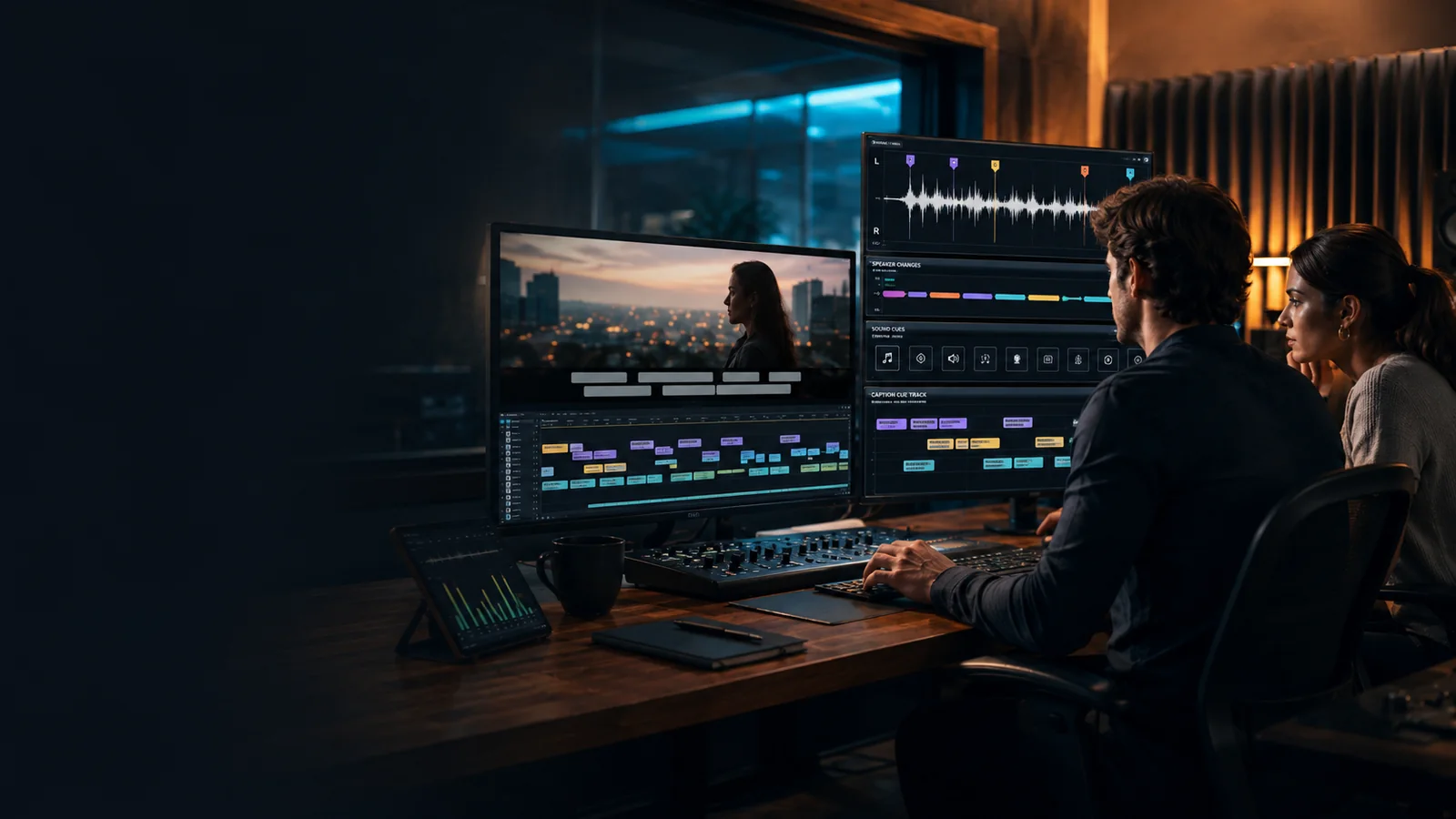


Subtitle creation and translation from one supplier
Some projects arrive with a complete subtitle template that only needs translating. Others arrive as a video with no transcript, no timecodes and no subtitle file.
We handle both situations.
When subtitles do not yet exist, the work can include transcription, spotting, segmentation, timecoding, text adaptation and final file preparation. When the original subtitles are already timed, we can translate and adapt them while preserving the relationship between dialogue, image and available reading time.
For multilingual releases, we can also create a source-language template and use it as the basis for several target-language versions.
Subtitling for production companies outside Spain
A UK, US or European production company may need a supplier in Spain for reasons that have little to do with the location of the production itself.
A British documentary may require Basque and Spanish subtitles for distribution in Spain. A US training programme may need Spanish, Catalan and Galician versions. A distributor may acquire a Basque-language film and require English subtitles for festivals and international sales.
In these situations, working with a translation company established in Spain makes it possible to coordinate the languages used locally while keeping the international versions under the same project management structure.
Materials and deliveries are normally handled online, so the client does not need to be located in Spain.
Spanish, Basque, Catalan, Valencian and Galician subtitles
Spain is a multilingual market and some audiovisual projects need more than a Spanish version.
We create and translate subtitles involving:
Spanish · Basque · Catalan · Valencian · Galician
These languages can be target languages or the original languages of a production.
We therefore handle projects such as English to Basque, English to Catalan, Basque to English, Catalan to English, Galician to Spanish and multilingual combinations involving several languages in the same video.
Our location in Bizkaia is particularly relevant for Basque-language projects. LinguaVox has worked from the Basque Country since 2000 and manages translation, interpreting and audiovisual language services involving Basque alongside other languages.
Documentary subtitling
Documentaries often contain the elements that make audiovisual translation most demanding: unscripted interviews, specialist terminology, archive footage, speakers who change language, place names, institutions and cultural references.
We can create subtitles from raw footage or translate a prepared subtitle template.
When reference material is available, we use it to check names, technical terminology and contextual information. A documentary about industry, history, medicine or science needs different research from a travel programme or a personal interview.
The subtitle must remain readable without flattening the speaker’s meaning or introducing explanations that were not present in the original.
Film, television and streaming
Dialogue written for performance has to be treated as dialogue, not as isolated sentences.
Humour, irony, interruptions, relationships between characters and visual timing can all affect the translation. A subtitle that appears too early can reveal a punchline or response before the viewer should know it. A line that is technically accurate may still fail if it takes too long to read.
We prepare subtitle files for films, series, programmes, interviews and other content intended for television, festivals, streaming platforms and digital distribution.
Where a broadcaster, platform or distributor supplies its own timed-text specification, that specification becomes part of the project requirements.
Corporate video and e-learning
Subtitling is also used extensively outside entertainment.
We work with product videos, internal communications, interviews, webinars, conference recordings, safety material, software demonstrations, online courses and training libraries.
Terminology can be critical in these projects. Existing glossaries, approved translations, product documentation and style guides can be incorporated into the workflow so that the subtitles use the same terminology as the rest of the client’s content.
For recurring series of videos, we can maintain the same linguistic decisions across successive deliveries.
Accessible subtitles, SDH and captions
Accessibility requirements differ from ordinary interlingual subtitle translation.
Subtitles for deaf and hard-of-hearing audiences may need to identify speakers and convey relevant sound, music or other audio information that a hearing viewer receives directly from the soundtrack.
The terminology also varies between markets and platforms. Clients may refer to SDH, accessible subtitles, captions or closed captions depending on the content and destination.
We define the required service before production begins and follow the relevant client, platform or delivery specification.
From video to timed-text file
A typical project may involve the following stages.
Material review
We check the video, source language, available scripts or subtitle files, target languages, delivery requirements and deadline.
Creation or import
If no subtitles exist, we prepare the timed source text. If a subtitle file already exists, we inspect it before translation.
Translation and adaptation
The target text is written for the time available on screen. Dialogue may need careful reformulation when a literal translation would be too long or unnatural.
Timing and segmentation checks
We check the relationship between text, audio, shot changes and subtitle events according to the service required.
Linguistic and technical QA
Names, terminology, punctuation, structure and file integrity are checked before delivery.
Delivery
The client receives the agreed timed-text files or other deliverables for editing, publishing or distribution.
Subtitle formats
We can work with common subtitle and timed-text formats, including:
SRT · WebVTT · STL · TTML · SCC
The correct format depends on the editing environment, platform, broadcaster or distribution workflow. If you do not know which file is required, tell us where the subtitles will be used and we can assess the delivery requirements before the project begins.
WebVTT, for example, is designed for timed text associated with web video and can carry subtitles or captions. Professional broadcast and distribution workflows may use other formats and additional specifications.
Human judgement and automation
Speech recognition and machine translation can be useful in some subtitling workflows, but they do not remove the need to understand the audiovisual content.
Names, accents, overlapping speech, specialist terminology and poor audio can affect automatic transcription. Translation also requires decisions about reading time, segmentation, humour, register and cultural references.
We therefore decide whether automation is appropriate according to the material and the required result. When technology is used, the level of human review is defined as part of the service rather than assumed to be unnecessary.
How much does subtitling cost?
There is no useful single rate for every audiovisual project.
Cost depends on factors such as video duration, source and target languages, whether a transcript or timed file already exists, the quality of the audio, specialist content, accessibility requirements, number of language versions, delivery format and deadline.
Translating a clean, fully timed SRT is a different job from creating subtitles from an unscripted documentary with several speakers.
Send us the files, or provide the duration and project details if the video cannot yet be shared. We will confirm the scope, price, delivery format and expected turnaround before work begins.
LinguaVox in Spain
LinguaVox was founded in 2000 and has its head office in Santurtzi, Bizkaia, Spain. We manage professional translation and multilingual projects in more than 150 languages for companies and organisations in Spain and abroad.
Subtitling projects can be handled entirely online, including quotation, secure file exchange, project management and delivery.
This makes the service suitable both for local productions and for international clients specifically looking for a subtitling supplier established in Spain.
Frequently asked questions
Can you work with a UK or US production company?
Yes. Projects are normally managed online and we work with clients outside Spain. We can receive the video and subtitle assets, confirm the required languages and formats, and deliver the completed files without the client needing a local office.
Can you subtitle a film into Basque as well as Spanish?
Yes. We can coordinate Spanish and Basque versions of the same production and can add Catalan, Valencian, Galician, English or other languages where required.
Can you translate from Basque into English?
Yes. Our work is not limited to translating into the languages of Spain. Basque, Catalan, Galician and Spanish can also be source languages for English and other international subtitle versions.
Do you need a subtitle file before you can quote?
Not always. We can quote from a timed subtitle file, transcript or video. If only the video is available, the quote can include subtitle creation as well as translation.
Can you create one template and translate it into several languages?
Yes. For multilingual projects, a reviewed source or pivot template can provide a consistent basis for downstream language versions. Individual languages can still require their own timing, segmentation or reading adjustments.
Do you provide closed captions or SDH?
We can provide accessible timed text when the project requires it. The exact service should be defined according to the destination because terminology and technical expectations differ between platforms and markets.
What subtitle formats can you deliver?
We work with common formats including SRT, WebVTT, STL, TTML and SCC. The appropriate choice depends on the client’s editing, publishing or distribution workflow.
How do I request a quote?
Send the video or subtitle file if possible, together with the source language, target languages, approximate duration, required delivery format and deadline. If reference material or a style guide exists, include that as well.